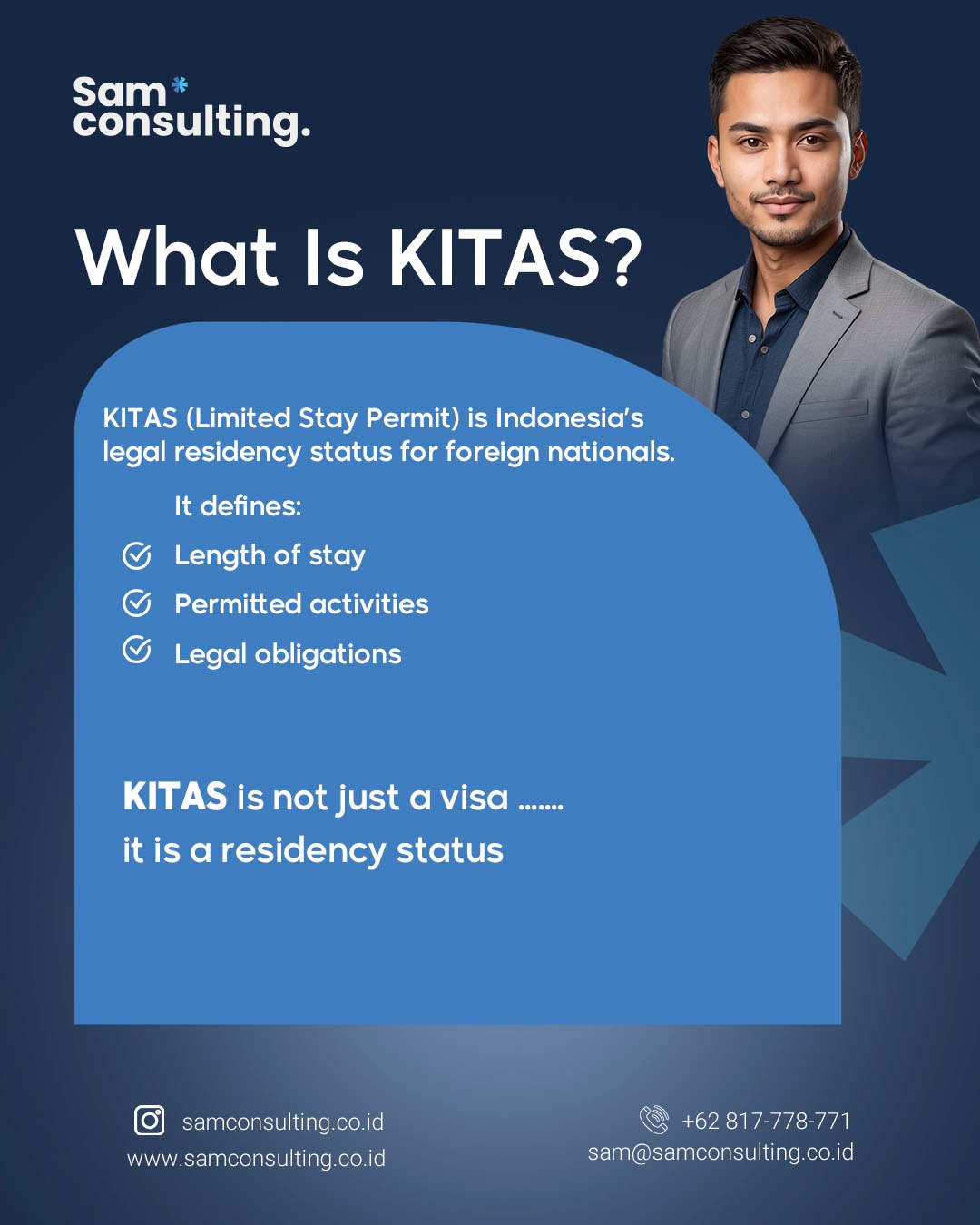
Living, working, or investing in Indonesia requires more than entering the country with a valid visa. If you plan to stay medium- or long-term, you must understand Indonesia’s structured residency system. At the center of this framework stands the KITAS (Kartu Izin Tinggal Terbatas). This permit defines your legal status, your permitted activities, and the duration of your stay. Therefore, choosing the correct KITAS category is critical for compliance and long-term planning. What Is a KITAS? A KITAS is Indonesia’s Limited Stay Permit. It allows foreign nationals to reside in the country for a specific purpose and period. Unlike a regular visa, KITAS grants residency status under immigration law. In practice, KITAS determines: How long you may stay What activities you may perform What obligations you must fulfill VITAS vs ITAS vs KITAS: Understanding the Difference Many foreigners confuse these terms. However, they represent different stages. VITAS is an entry visa. Immigration issues it before you arrive in Indonesia. It allows entry but does not grant residency. ITAS is the actual stay permit. Immigration grants it after you complete registration and biometrics. KITAS is the commonly used term for ITAS in daily practice. Therefore, a visa alone does not give residency rights. Only ITAS (KITAS) does. Why KITAS Matters? Holding the correct KITAS allows you to: Reside legally in Indonesia Open bank accounts Obtain a driving license Register with local authorities Build eligibility toward permanent residency (KITAP) Conversely, operating under the wrong permit may lead to fines, deportation, or entry bans. Which KITAS or Long-Term Permit Do You Need? Indonesia issues different permits depending on your legal purpose. Therefore, selecting the right category is essential, as each permit strictly limits what activities are allowed. Using the wrong permit—even unintentionally—can result in serious immigration consequences. 1. Work KITAS (Index E23) The Work KITAS applies to foreign professionals employed by Indonesian companies. To qualify, you must have: A sponsoring company Approved RPTKA (Foreign Manpower Utilization Plan) This permit ties you to a specific employer and position. Consequently, if you change jobs, you must apply for a new KITAS. 2. Investor KITAS (Index E28 Series) The Investor KITAS applies to shareholders and directors of PT PMA companies. Unlike Work KITAS, this permit is ownership-based. Moreover, it often offers longer validity—typically up to two years. It suits founders and strategic investors who manage their businesses directly. 3. Digital Nomad Visa (Index E33G) The Digital Nomad Visa allows remote professionals to reside in Indonesia while working for overseas clients. However, income must originate entirely outside Indonesia. In addition, you may not engage with Indonesian clients or receive local payments. This visa is valid for up to one year and remains renewable if you meet the conditions. 4. Family KITAS Family KITAS allows dependents of KITAS holders or foreign spouses of Indonesian citizens to reside legally. However, it does not grant work rights. Therefore, if you intend to work, you must obtain separate authorization. Although holders do not work, they must still comply with reporting and renewal requirements. 5. Retirement & Long-Term Residency options: Indonesia offers several long-term stay options specifically designed for non-working foreign residents, catering to individuals who wish to reside in the country for lifestyle, retirement, or strategic residence purposes without engaging in local employment. These options differ in duration, financial requirements, and legal scope, but all are structured to allow lawful residence while clearly restricting participation in Indonesia’s labor market. The Retirement KITAS (Index E33F) is available to foreign nationals aged 60 years and above. Applicants must demonstrate sufficient financial capacity to support themselves during their stay and provide proof of long-term accommodation in Indonesia, either through ownership or a formal lease. This permit is intended solely for retirement and residential living and strictly prohibits any form of employment or business activity within Indonesia. The Second Home Visa (Index E33) provides a longer residency option of five to ten years and does not require a local sponsor. Eligibility is based on proof of substantial financial means, such as a qualifying bank balance or ownership of high-value residential property in Indonesia. This visa is particularly suitable for individuals and families seeking long-term stability and repeated residence without employment obligations. The Golden Visa (Indexes E28B, E28C, and E28D)https://samkonsulting.com/golden-visa-in-indonesia/ targets high-net-worth individuals and strategic investors. This program grants extended residency rights in exchange for regulated investments, such as government bonds, equity participation, bank deposits, or capital investment in Indonesian companies. The Golden Visa offers enhanced flexibility, longer validity periods, and administrative privileges, making it a strategic residency option for individuals with significant financial and investment interests in Indonesia. 6. Special Categories Special residency categories in Indonesia are designed for specific purposes outside employment or investment: The Ex-Indonesian Citizen Stay Permit (E32) allows former Indonesian nationals who have obtained foreign citizenship to reside in Indonesia for extended periods (1 – 10 years stay time). This permit is subject to strict eligibility criteria, proof of former nationality, and ongoing immigration compliance. The Student Stay Permit (E30) is issued to foreign nationals enrolled in accredited educational, research, or academic programs and requires sponsorship by a recognized institution. It is valid for 6 months to 2 years stay permit. Both permits are strictly purpose-specific and do not permit employment or commercial activities beyond their approved scope. The KITAS Application Process The KITAS application process generally consists of four stages: First, a valid sponsor must be established, whether a company, spouse, or institution. Second, an offshore e-Visa (VITAS) is issued prior to entry. Third, upon arrival, the applicant completes biometrics and registration at immigration. Finally, the digital KITAS is issued electronically. (sent by email) Physical KITAS cards are no longer provided under current regulations. Mandatory Post-KITAS Registrations After receiving a KITAS, additional registrations may be legally required depending on the permit type and duration of stay. These may include: SKTT (Surat Keterangan Tempat Tinggal) is a civil registration with the local population office confirming the foreigner’s residential address. STM (Surat Tanda Melapor) is a mandatory notification to the local