
Setting up a company in Indonesia as a foreigner?
- We check your KBLI and foreign-ownership limits first
- Deed, Ministry approval, tax number and NIB handled for you
- Bank account, KITAS and ongoing compliance in one place
- Choose the right business entity
- Check foreign ownership limits
- Capital and investment requirements
- Documents you need
- Choosing your company name
- Step-by-step registration
- Risk-based business licensing
- Setting up with a local partner
- Starting a digital business
- After registration: staying compliant
- Common mistakes
- FAQ
1. Choose the right business entity
Foreign investors have three main options. Pick the one that matches what you want to do in Indonesia.
| Entity | Who owns it | Can it earn revenue? | Best for |
|---|---|---|---|
| PT PMA (foreign-owned PT) | Foreign individuals or companies, alone or with local partners | Yes | Operating a business, hiring staff, sponsoring KITAS |
| PT (local) | Indonesian citizens or Indonesian companies only | Yes | Local founders; foreigners can only be directors or employees |
| Representative office (KPPA) | A foreign parent company | No: market research and liaison only | Testing the market before investing |
Not sure which fits? Our guide to types of companies in Indonesia compares every entity, including CV, firma and foundations.
2. Check foreign ownership limits
Every business activity has a five-digit KBLI code (Indonesian Standard Industrial Classification). The Positive Investment List (Presidential Regulation 10/2021, amended by 49/2021) sets out, for each KBLI:
- Open to 100% foreign ownership: most activities after the Omnibus Law reforms
- Open with limits: a foreign ownership cap or other conditions
- Reserved: for cooperatives and small businesses, or partnerships with them
- Closed: to all investment, such as certain government activities
Pick your KBLI codes before anything else. They decide your ownership structure, capital, licences and whether you can use a virtual office.
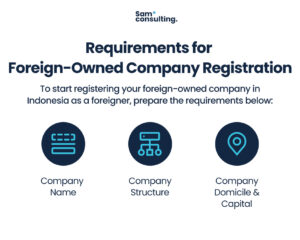
3. Capital and investment requirements
| Requirement | Rule under BKPM Regulation 5/2025 |
|---|---|
| Total investment plan | Above IDR 10 billion per five-digit KBLI per project location, excluding land and buildings |
| Issued and paid-up capital | At least IDR 2.5 billion, paid into the company’s bank account |
| Use of paid-up capital | Kept in the company account for a period after paying in, except for operational use and asset purchases. Check the current rule |
| Reporting | Investment progress reported every quarter through LKPM |
Capital rules have changed several times in recent years. Always confirm the current figures on oss.go.id or bkpm.go.id, or ask us, before you plan your budget.
4. Documents you need
- Passport copies of foreign shareholders, directors and commissioners
- For corporate shareholders: articles of association, certificate of incorporation and a board resolution, legalised and translated as required
- Tax numbers (NPWP) of any Indonesian shareholders or officers
- Proposed company names (see below)
- Planned KBLI codes and a short description of the business
- Registered office address, for example a lease or virtual office agreement
- Capital structure and shareholding percentages
5. Choosing your company name
The name is reserved online with the Ministry of Law before the deed is signed. The main rules:
- At least three words, for example “PT Nusantara Green Energy”. Two-word names are normally rejected.
- Language: a local PT must use Indonesian. A PT PMA may use a foreign language, written in the Latin alphabet.
- Unique: not identical or confusingly similar to an existing company, including inactive ones.
- Not similar to government bodies, international organisations or well-known brands you don’t own.
- No numbers, symbols or meaningless letter combinations, and nothing contrary to public order or morality.
- No words that describe a business type, such as “Joint Venture” or “Holding”, unless they reflect the actual structure.
A reserved name is held for a limited period, usually 60 days, while the deed is signed. Prepare two or three alternatives in case your first choice is taken.
6. Step-by-step registration
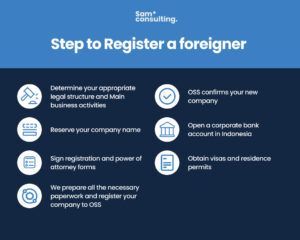
- Structure check. Confirm KBLI codes, foreign ownership limits, capital and address requirements.
- Name reservation with the Ministry of Law.
- Deed of establishment signed before an Indonesian notary. This can be done by power of attorney if you are abroad.
- Ministry of Law approval of the deed, which gives the company its legal status.
- Company tax number (NPWP) registration.
- NIB (Business Identification Number) through the OSS system.
- Business licences under risk-based licensing: a certificate of standards or a licence, depending on risk.
- Corporate bank account and paying in the capital.
- Visas and KITAS for shareholders, directors and foreign staff.
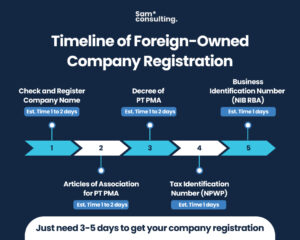
Timing depends on your activity, its risk level and how quickly documents are signed and legalised. We confirm your timeline in writing before you start.
7. Risk-based business licensing
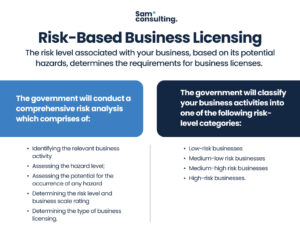
Indonesia licenses businesses by risk level through the OSS system:
| Risk level | What you need |
|---|---|
| Low | NIB only |
| Medium-low | NIB plus a self-declared certificate of standards |
| Medium-high | NIB plus a certificate of standards verified by the authorities |
| High | NIB plus a licence approved by the authorities, sometimes with an environmental approval |
The lower your risk level, the simpler and faster the licensing. Each KBLI code can carry a different risk level.
8. Setting up with a local partner (joint venture)
A joint venture is a PT PMA with both foreign and Indonesian shareholders. It is common when your KBLI caps foreign ownership, or when a partner brings licences, land or market access. The key is a strong shareholders’ agreement that covers control, profit sharing, deadlock and exit. Never use nominee arrangements: they are not recognised by Indonesian law and leave the foreign investor unprotected.
Read our full guide: Joint venture in Indonesia: structure, partners and agreements.
9. Starting a digital business
Indonesia has the largest digital economy in Southeast Asia, and many digital activities are open to foreign ownership. Common KBLI codes include online retail (e-commerce), software development, IT consulting and digital platforms. Points to check:
- The right KBLI: online marketplaces, retail through your own website and software services use different codes with different requirements.
- Electronic system registration (PSE): platforms and apps that serve Indonesian users usually must register as an Electronic System Operator.
- Fintech such as payments, lending or crowdfunding is regulated separately by Bank Indonesia or OJK and needs its own licence.
- Data protection: Law 27/2022 on Personal Data Protection applies to how you collect and store customer data.
10. After registration: staying compliant
- LKPM: a quarterly investment activity report to BKPM. See our LKPM reporting service.
- Tax: monthly tax payments and returns, plus an annual corporate tax return. See tax services.
- Accounting: bookkeeping and financial statements. See accounting services.
- BPJS: health and employment insurance for staff. See BPJS guide.
- Annual report and corporate updates. See company compliance.
11. Common mistakes foreign founders make
- Choosing KBLI codes too late, then finding the activity is capped or needs a different licence.
- Using a nominee to avoid ownership limits. It carries a high risk of losing the business.
- Underestimating capital rules and the quarterly LKPM obligation.
- Using an address in the wrong zone for the activity.
- Treating setup as the finish line. Missed tax and LKPM filings lead to penalties and can block KITAS renewals.
12. Frequently asked questions
Can a foreigner open a company in Indonesia?
Yes. Foreigners set up a PT PMA, a foreign-owned limited liability company. Many business activities allow 100% foreign ownership. Some are capped or reserved for Indonesians, so check your KBLI code against the Positive Investment List first.
How much capital does a PT PMA need?
Under BKPM Regulation 5/2025, a PT PMA needs a total investment plan above IDR 10 billion per five-digit KBLI per project location, excluding land and buildings. The minimum issued and paid-up capital is IDR 2.5 billion. Check current rules on OSS or BKPM before you plan, because they change.
How many shareholders and directors do I need?
At least two shareholders, who can be individuals or companies, plus at least one director and one commissioner. A foreigner can be a director, but some positions, such as HR director, are reserved for Indonesians.
Can I be a 100% owner of my company?
You can own 100% of the business if your KBLI is fully open to foreign investment. You still need at least two shareholders, for example you and your holding company, or you and a second foreign individual.
Do I need a physical office?
Every company needs a registered address in a zone that allows your activity. Many service and trading companies start with a virtual office. Some licences, such as manufacturing or warehousing, need a physical site.
Can I get a KITAS through my company?
Yes. Once the company is set up, it can sponsor an Investor KITAS for shareholders or a Work KITAS for directors and staff, depending on your role and shareholding.
What happens after the company is registered?
You open a corporate bank account, pay in the capital, register for tax and BPJS, and file the LKPM investment report every quarter. Monthly and annual tax filings follow.
How long does company setup take?
It depends on your business activity, its risk level and how quickly documents are signed. We give you a written timeline for your case before you start.
Last reviewed: October 2026. Regulations, capital requirements and procedures change. Confirm current requirements with BKPM, OSS or our team before you make decisions.
Ready to set up your company?
Tell us what you want to do in Indonesia. We’ll confirm your KBLI, ownership and capital, and give you a written quote and timeline before you pay.